Chinese Coins: Panda Medals or Panda Coins?
發佈 於 2014/4/15
作者:
Peter Anthony
“Is this a coin or a medal?” is a common question. The answer usually depends upon whether there’s a face value. A coin has one while a medal doesn’t. But there are exceptions. For instance, what to make of the 1982 Pandas? They lack denominations but most people consider them coins.
Way back in 1980-81 the China Mint wanted to issue a new bullion coin. They chose the Panda for the coin’s theme and considered many different designs. These patterns had denominations. In the end the denomination was dropped to better compete with the South African Krugerrand, the world’s most popular gold coin at the time.
People immediately asked, “Are Pandas medals or coins?” The China Mint insists that Pandas are coins and most collectors accept that but the acknowledgement is not universal. Some catalogues still classify the 1982 Pandas as medals. In 1983 the Mint started to include denominations on the coins to prevent any further controversy.
From 1984 through 1997 the China Mint minted both Panda coins and Panda medals. Each medal had a its own individual design that differed from that year’s Panda coins. The very first was a 1 oz. sterling silver piece minted for the 1984 Hong Kong, China International Coin Exposition. Just 1,000 were released and they have become very sought after items.
By the mid-nineties change was afoot. The Mint-sponsored medal program had been reduced to two per year and a new style of commemorative Panda coin emerged. At the 1995 Beijing Coin Expo a special 10 Yuan silver Panda coin was released. The reverse, or Panda side, is identical to the 1995 10 Yuan Large Date coin. On the obverse, or date side, an inscription that identifies the Expo was added.
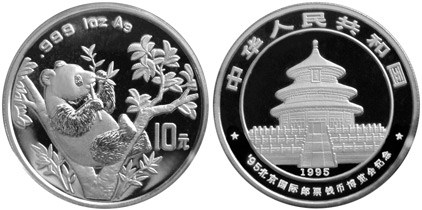
The 1995 Beijing Expo Panda is the first Panda coin issued to
commemorate an event.
The new style harmonizes the current year Panda design with that of the commemorative coins. It would soon become the standard. Two such silver coins were struck in 1996: the 10 Yuan 9th Asian International Philatelic Exposition and the 10 Yuan 1996 Beijing International Coin Expo. The Beijing coin is especially interesting as it is the first Panda with a small gold inset called a privy mark.
In 1997 there were four more new style silver coins minted: the 10 Yuan China Year of Tourism (“Visit China”), the 10 Yuan Shanghai International Stamp and Coin Expo, the 10 Yuan Founding of ChongQing Municiaplity, and the 5 Yuan Hong Kong International Convention. 1997 was also the final year for Mint-sponsored Panda medals; a pair of gold and silver medals for the Munich International Coin Show.
The reaction of collectors to this new style has been mixed. Some of the coins have attracted strong interest due to their scarcity. Others, however, are among the most overlooked coins in the entire Panda series. In particular a market for the 100 Yuan ¼ oz. gold commemorative Pandas has not yet developed.
Examples of popular 10 Yuan silver coins are the 1995 and 1996 Beijing Pandas, the 1997 “Visit China,” the 2007 Xi’an City Commercial Bank, the 20th Anniversary of China CITIC Bank and the 2008 100th Anniversary of Beijing Banknote.
The 1997 “Visit China” or “Year of Tourism” is a moderately priced coin that is well worth a look. It’s usually seen with a dull, unattractive luster but can occasionally be found with beautiful mirrored fields.
The 1997 and 1998 5 Yuan Hong Kong International Convention coins are neither expensive nor common. They are typically well-struck, have beautiful designs and are quite enjoyable. Which is something that can be said for all the commemorative Pandas.
Peter Anthony is an expert on Chinese modern coins with a particular focus on Panda coins. He is an analyst for the NGC Chinese Modern Coin Price Guide as well as a consultant on Chinese modern coins.