Chinese Coins: Panda Pair-adise
發佈 於 2014/2/18
作者:
Peter Anthony
February is the second month of the year so it seems like a good time to look at Pandas that come in twos. We already know that the 1989 NYINC medals have a horse on one side and a Panda on the other. Are there any other Pandas with animals on both faces? Yes, there sure are.
The second Panda with animals on both faces is a 1/10 oz. gold medal that was issued in 1992 for the 20th Anniversary of the Normalization of Sino-Japanese Diplomatic Relations. The normalization of the relations between China and Japan after decades of bitterness was a diplomatic milestone. China released three gold Panda medals in 1987 to mark the 15th anniversary of the pact. Five years later the 1992 20th Anniversary medals were put on sale at the Tokyo Coin Show with Taisei Coins handling the distribution.
The medal design has a pair of Pandas on one side and a pair of cranes on the other. The crane represents longevity and auspiciousness in Chinese tradition. The image of a pair of these esteemed birds flying side-by-side symbolizes harmony between the two nations. The medal was shipped in a beautiful wooden box with the image of a pair of cranes in flight on it. Its official mintage is 3,000.
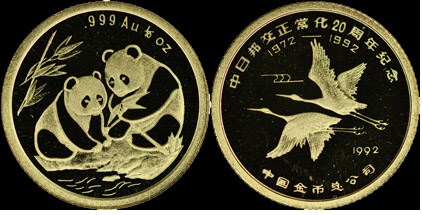
China 1992 Gold Panda Sino-Japanese 20th Anniversary 1/10 oz. Medal
It’s not unusual to find two Pandas on one side of a coin, but how about Pandas on both sides? 2002 was the 20th anniversary of the Panda series. To mark the passing of 20 years the China Mint struck 20,000 1/10 oz. platinum coins. These have the design of the 1982 coins on the obverse while the reverse side carries the standard 2002 image of a bear striding through a bamboo forest.
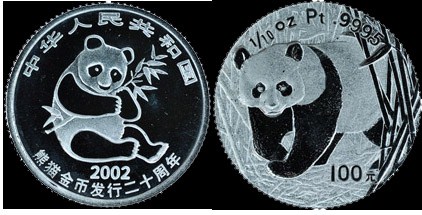
China 2002 Platinum Panda 20th Anniversary 1/10 oz. Medal
If legendary creatures qualify then there are a couple of more Pandas with two animals on them. At the 1988 Hong Kong, China Expo a pair of medals with both dragons and pandas on them were issued: a 5 oz. silver and a 1 oz. gold. The silver medal sports perhaps the most whimsical design of any China Mint panda. On the reverse five small bears dance around while each holds up a stick to support a long effigy of a dragon. The obverse of this medal features a dragon’s head inside a central circle. Mintage is 1,000 and the medals are not easy to find. The gold medal similarly has a Panda on one side and a dragon on the other. It has the lowest official mintage of any China Mint 1 oz. gold medal: 500.
As an aside, 1988 was near the end of the road for the 1 oz. gold Panda medal series. This is reflected in the mintage figures that are lower than previous years. Even these reduced official numbers may understate the decline. There is one 1988 Panda gold medal which is reliably reported to have a true mintage well below 500. What caused the decline? The early medals had instantly gone up in price. Early buyers could instantly flip the medals and turn a profit. By mid-1988 the market was saturated by the nine 1 oz. gold Panda medals released within three years. Demand fell, dealers cancelled orders and the number of medals actually struck was cut back.
Today the low mintages and low survival rates of many Pandas have made them scarce. It is often a real challenge to put together Panda sets. The Dragon is a traditional Chinese symbol of power, strength and good luck for the deserving. These are qualities that all numismatists can use as they search for Panda coins and medals.
Peter Anthony is an expert on Chinese modern coins with a particular focus on Panda coins. He is an analyst for the NGC Chinese Modern Coin Price Guide as well as a consultant on Chinese modern coins.
保持了解
您希望我們每月將新消息發送至您的電子郵箱嗎?現在就來訂閱免費的NGC電子月報吧!